
The Architecture of Cruelty
Since January 2025, the United States has formed agreements with at least 35 countries to transfer migrants and refugees to countries with which they have no prior connection. The texts underlying the arrangements with 29 of these countries — a total of 33 agreements — are publicly available.
Below are key patterns in these agreements' content and form, and changes across agreements over time.
Today, we are witnessing one of the most horrendous attacks on immigrant communities in U.S. history. The Trump Administration's mass removal policies are systematic, pervasive and coordinated with maximum intent to terrorize immigrants. The policies are characterized by roving bands of masked, unnamed officers in unmarked cars making violent and random arrests;1a1b1c prolonged detention in inhumane conditions,2a2b with transfers ever further away from the immigrant's home; attacks on the immigration law system, including drastic reductions in the decision-making power of immigration judges and the wholesale firing of over 130 of them,3 to newly promulgated rules to reduce the work of asylum offices;4 a failed locator system that means relatives cannot find their loved ones;5a5b5c and forcible removals. Thousands of immigrants across the United States are experiencing the antithesis of their fundamental right to human dignity.
This dashboard, which accompanies our report, helps illuminate the architecture underlying a crucial dimension of this overarching system of cruelty: the removal arrangements that the Trump administration has concluded with approximately three dozen countries to facilitate the transfer of refugees and migrants abroad. Our work identifies and analyzes these documents and – where we could find them – the plans for implementing the agreements. Collectively, our findings constitute the first major analysis of the removal arrangements that have allowed this system to function, one riddled with violations of both domestic and international human rights protections. In creating agreements with countries across the globe, the U.S. is creating a growing coterie of allies, who join in the global project of eviscerating the fundamental rights to asylum and refugee protection.
Underlying our work is our concern and regard for the people who have been and will be most affected by these transfers. Over the past year and a half, we have witnessed the transfers of thousands of people in real time. We know they have been moved to U.S. detention centers that are nothing more than staging warehouses for processing deportations. We know that many have been chained and straight-jacketed during their many-hours-long transfers. We know that most arrive in a foreign country with no prior knowledge of where they have been sent. We know that many have endured horrendous conditions in these countries without receiving any information about what will happen to them. We know that many have been pressured or forcibly sent to the home countries from which they previously fled and from which they gained protective status in the United States. We know that refoulement has occurred, constituting violations of international obligations of both the U.S. and its partner countries.
Ultimately, the U.S. government's removal arrangements violate the human rights of refugees and migrants around the world, both on the page and in practice. In response, we will continue our investigation into the ways law and diplomacy are being weaponized against migrants; support the efforts of investigative journalists, lawyers, and human rights defenders to protect those most impacted by this architecture of cruelty; and expose the intent, implementation and human suffering caused by these transfer agreements.
We need to get better at treating this like a business…like Amazon (prime) but with human beings.
Introduction to Third Country Removals
Third country removal arrangements are the processes by which representatives from the United States and another country negotiate terms for sending refugees and migrants from the United States to a third country with which the refugee or migrant has no prior connections and may not even speak the language. In March 2025, an internal memo by Kristi Noem, then Secretary of the Department of Homeland Security, set forth guidance on conducting third country removals to DHS employees with the directive that, "Immigration officers will not affirmatively ask whether the alien is afraid of being removed to that country." Separately, the following month, ICE acting director Todd Lyons gave the keynote address at the Border Security Expo proclaiming, "We need to get better at treating this like a business...like Amazon (prime) but with human beings."6 Together, these remarks speak to the new reality of mass deportations from the U.S. – arresting immigrants in never seen before numbers while intentionally avoiding asking them questions that would trigger international refugee protections. While the use of removal agreements is not new, the second Trump Administration has exponentially expanded their scale and purpose, and altered their removal processes.
How to read this
One sheet, one agreementEach sheet of paper is a single deal with a single government. Select it to pull the country's file.
Hatched means unseenThe text has never been published. We know the deal exists from reporting; we cannot read its terms.
The drawers changeBetween one question and the next the sheets gather into a single pile, then get dealt out again — by format, protections, money, silence.
Thirty-nine arrangements. Thirty-five countries. Ten ways to sort them. Keep scrolling
Disclosure Requirements
The Case-Zablocki Act, 1 U.S.C. § 112b, requires the executive to transmit to Congress and publish for the public the texts of international agreements and some nonbinding instruments. Third country removal arrangements satisfy this definition because they are concluded with foreign governments and reflect a commitment by another state to receive noncitizens removed from the United States.
Under the Act, the Secretary of State must make the full text of an international agreement and any related materials publicly available no later than 120 days after the agreement enters into force, unless an exception applies. Despite these disclosure requirements, at the time of writing, not every third-country removal agreement has been published, and nearly every operating plan has been withheld.
As a result – and in violation of the law – the public lacks access to critical information about these arrangements, including, in some cases, the number of people who may be transferred, the criteria receiving states use to accept or reject refugees and migrants for removal, the procedures that will govern post-transfer treatment, and the financial or logistical support provided by the United States.
The non-disclosure of removal agreements and implementation plans, and reliance on the use of MOUs and diplomatic notes, may reflect an intent on the part of the Trump administration to end-run the Case Act.
This opacity does more than limit public knowledge. It weakens oversight, inhibits legal challenges, and leaves affected refugees and migrants without access to the terms that directly impact their lives.
Discretionary Terms: Selection, Acceptance, and Rejection of People for Removal
Close review of all publicly available agreement texts spotlights when and where receiving countries have negotiated their own terms and conditions. The word "discretion" is specifically used to indicate where the receiving country has final authority.
The agreements give receiving states varying degrees of discretion over both who may be transferred and what protections, if any, people who have been transferred receive after arrival. This discretion manifests in two ways. First, many agreements allow receiving states to limit, screen, accept, or reject migrants proposed for removal based on numerical caps, nationality, age, medical history, criminal history, professional skills, or other criteria. Second, once a transfer is completed, the agreements leave the receiving state responsible for determining the transferee's legal status, access to protection, length of stay in the receiving country, and treatment under domestic law.
This structure is central to the agreements' design. The United States retains control over initiating removals, proposing specific refugees and migrants for removal, and completing the transfer. But after removal, the agreements shift responsibility for ongoing protection or transfer, status, and services onto receiving countries. The absence of any further oversight by or reporting requirements to the US indicates that the US is drawing a line once the transfer occurs.
In short, the United States limits its own obligations by relying on receiving countries that may not, or demonstrably do not, have the capacity, legal infrastructure, or political will to guarantee meaningful protection.
By structuring these agreements to recognize the receiving country's role while omitting any reference to its own international obligations, the U.S. disclaims any responsibility for what happens to the migrants and refugees it transfers.
Protections on Paper and in Practice
In March 2025, former DHS Secretary Kristi Noem issued a consequential memorandum titled "Guidance Regarding Third Country Removals." This memorandum establishes that third country "assurances" are determinative; if a receiving country assures the U.S. that it will protect any transferred person from persecution, that assurance will trump the individual's right to a hearing.
If a country "assures" the United States that it won't persecute people, then the U.S. will continue to send refugees and migrants to that country without the benefit of an individual hearing. Many of the agreements explicitly state broad assurances of protection from persecution, both in the receiving country and in any other country to which refugees and migrants may be subsequently sent.
Protections on Paper
Most agreements assert that both parties – the U.S. and receiving countries – will act in accordance with the countries' respective international obligations.
Protections in Practice: Deficient Refugee Systems
In practice, even those states that pledge protection frequently lack the legal infrastructure to deliver on those promises. Without implementing laws and procedures, a country cannot provide what the agreements promise. Hence, the existence of a functioning protection system in the receiving country is foundational to the agreements.
Many receiving countries have asylum or refugee protection laws on the books but no ability to implement them. For example, Cabo Verde does not have a functioning asylum system, despite having a national asylum law.
Protections in Practice: Onward Transfers
The principle of non-refoulement prohibits a country from returning any person to any territory where there are grounds for believing that they would face persecution, torture, or cruel, inhuman or degrading treatment or other serious harm. The Refugee Convention and Convention Against Torture prohibit refoulement. Chain refoulement refers to sending a foreign national in one country to another country (a so-called "third country") and then transferring that same person to yet another country where they would likely face persecution. These international treaties prohibit any transfer – be it first, second, third, fourth or beyond – to any country where a person's life or freedom would be threatened. These treaties also prohibit sending a person to a third country as a mere stopping point for onward transfer back to a country where a person faces persecution or torture.
Despite nearly every agreement containing assurances to uphold the principle of non-refoulement and other legal obligations, many affected parties are subjected to forcible return to their home countries, or other countries where they face persecution. This is chain refoulement in action.
The agreement signed with the United States states: you're going to come here and then we're going to send you back. You're going to return to your country.
Changes over Time
The form and content of third-country removal agreements has evolved over time. The following section summarizes key trends in how agreements have changed through shifts in (1) instrument form and title, (2) publication, (3) language (4) protections for refugees and migrants, and (5) descriptions of the arrangements. These indicators demonstrate a shift away from clear commitments to protection and towards nonbinding language and vague assurances.
(1) Shift from Binding Agreements to Nonbinding Instruments
The clearest structural change is the disappearance of formal signed agreements after 2025. Of the fifteen arrangements finalized between March 2025 and 19 November 2025, four ACAs were formal signed agreements, seven agreements were exchanges of diplomatic notes, and four were memoranda of understanding. Of the sixteen arrangements finalized since November 19, 2025, nine are exchanges of diplomatic notes and seven are memoranda of understanding. Cabo Verde was the last of the asylum cooperation agreements; every arrangement finalized since has been a removal agreement.
After the Cabo Verde arrangement, however, no document uses the word "agreement" at all; instead, they are referred to as "understandings," "memoranda," and similar terms.
(2) Shifts in the Publication of Agreements and Related Documents
Cabo Verde is the last arrangement to be published in either the Federal Register or the Treaties and Other International Acts Series. Subsequent arrangements have been officially publicized only through the State Department's website. This change in publication practice indicates that the State Department is not treating the post-Cabo Verde arrangements as binding international agreements.
(3) Shifts in Binding Language
The State Department did not simply stop using formal signed agreements. It also stopped using the terminology that its own guidance associates with binding international agreements and adopted the terminology recommended for nonbinding documents. Changes in form, title, self-reference, and publication demonstrate that the United States has shifted from a mixed practice of binding and nonbinding arrangements to exclusive reliance on nonbinding instruments.
(4) Shift in Diplomatic Assurances and Protective Language
This shift towards nonbinding language has practical significance because it weakens receiving states' commitments to migrants and refugees transferred under such agreements. The March 2025 Honduras ACA uses the strongest language: "Honduras shall not return or expel a Protection Applicant" before a final administrative decision on the individual's protection request. The May 2025 arrangement with South Sudan states that South Sudan "will treat" transferred individuals consistently with its international human-rights obligations and "will not send" them to a country where they would face a likelihood of persecution. By October, Equatorial Guinea "assures" the United States that it "intends to treat" transferred third-country nationals consistently with its obligations. Under the November 2025 agreement, Sierra Leone "assures" the United States that it "would treat" transferred people consistently with its international legal obligations and that those individuals "would not be subjected to persecution." The sequence moves from a mandatory prohibition, to a stated future commitment, to an assurance of intent, and finally to an assurance framed in conditional terms.
Of the sixteen agreements concluded after Cabo Verde (the final ACA), only the agreement with the Dominican Republic references protection requests.
(5) Changes to Agreement Descriptions
The vocabulary used to describe the arrangements has also changed. Early agreement titles framed the objective as one of deportation, removal, or the examination of protection claims. Later agreements increasingly use the term "transfer." Costa Rica and Paraguay illustrate this shift. Costa Rica's 2025 agreement concerned "assistance for the deportation of irregular migrants," while its 2026 agreement concerns the "transfer of third-country nationals." Similarly, Paraguay's first agreement was for "the examination of protection requests," while its 2026 agreement is for "the transfer of third-country nationals."
By 2026, in describing the forcible movement of refugees and migrants from the U.S. to a third country, the agreements generally used "transfer," rather than "removal."
* Seventeen agreements refer to the “removal” of third-country nationals, but in nine of them the term appears only in a protection assurance clause stating that the receiving country will not remove an individual to a place where the person would face persecution or torture. These nine are excluded from this visual because “remove” appears only within a recurring boilerplate assurance clause and nowhere else in the operative text. These nine are Burundi, Cameroon, CAR, Dominica, DRC, Ecuador (2026), Grenada, Saint Kitts and Nevis, Sierra Leone.
That few of the agreements are framed as binding further undermines the human rights of those being transferred out of the United States.
Agreements as Leverage
In the first few months of the second Trump Administration, it quickly became clear that the "America First" foreign policy strategy champions what other countries can do for the U.S.. Early implementation of visa restrictions, travel bans and the gutting of funding for critical humanitarian aid around the world immediately placed the United States in an advantageous negotiating position with governments that were suddenly facing the disappearance of billions of dollars in promised aid.
Against this backdrop, the State Department quickly sent envoys and required ambassadors across the globe to negotiate new third country removal agreements. The department negotiated using a combination of templates and unique texts that have evolved over time, requesting the acceptance of refugees and migrants in return for financial and humanitarian aid.
Several foreign governments have expressly stated feeling pressured to sign a removal agreement to get back financial assistance. Others have alluded to promises of lifting visa restrictions in the United States or suggestions by US representatives that the acceptance of third-country nationals was needed to strengthen diplomatic relations.
Twenty-four agreements disclaim any obligation to provide funding. The absence of funding terms in an agreement does not indicate an absence of U.S. funding. The Equatorial Guinea agreement, for example, makes no reference to funds, yet the United States paid the government of Equatorial Guinea $7.5 million directly in connection with the removal agreement.
Three of the countries who explicitly agree to accept persons "who raise national security or public safety concerns" received the largest grants, totalling over $100million. These grant amounts reframe the meaning of clauses in removal agreements that disclaim any funding obligations. Therefore, language of this kind should not be read as evidence that the arrangement was unfunded or funding commitments were not integral to negotiations.
Collectively, this research starts to illustrate how removal agreements – as well as the refugees and migrants caught in the crosshairs of the Trump administration's removal policy – are pawns in a larger, evolving foreign policy strategy.
 The Architecture of Cruelty
What the agreements show
Agreements include discretionary language over the selection, acceptance, and rejection of people slated for removal
The agreements give receiving states varying degrees of discretion over both who may be transferred and what protections, if any, people who have been transferred receive after arrival.
The agreements contain diplomatically agreed-to assurances with clear discrepancies on paper versus in practice
Assessing those domestic regimes makes it clear that some receiving countries possess neither the legal framework nor the institutional capacity to honor their commitments, either under the agreements or under international law.
the agreements and funding are being used as leverage in broader foreign policy negotiations
Several foreign governments have expressly stated feeling pressured to sign a removal agreement to get back financial assistance.
the agreements' structures and framing has changed over time
These indicators demonstrate a shift away from commitments to protections and binding language, and towards nonbinding language and vague assurances.
Ultimately, the U.S. government's removal arrangements violate the human rights of refugees and migrants around the world, both on the page and in practice.
How we built this
The OSINT team focused on gathering open source information – data from online public sources – about third country arrangements. We collected a variety of sources, from social media posts to government documents and press releases to local news articles, that contained information on third country removals.
Consistent with the Berkeley Protocol on Digital Open Source Investigations, the researchers began by conducting a Digital Landscape Assessment for each country, mapping the digital ecosystem to identify where relevant data may be found and to better understand any potential digital and psychological risks of investigating on those platforms.
Because of the risk of documents being taken down or altered, we archived all references to removal arrangements immediately upon discovery. We collected and structured our data on a spreadsheet, which allowed us to create timelines and identify trends across third country removals. We worked on these country overview documents alongside our legal team, who concurrently microscopically examined the agreements using a detailed questionnaire template for each country.
Explore the reporting from our partners
Authors and Acknowledgments: This visualization was produced by UC Berkeley's Human Rights Center (HRC).
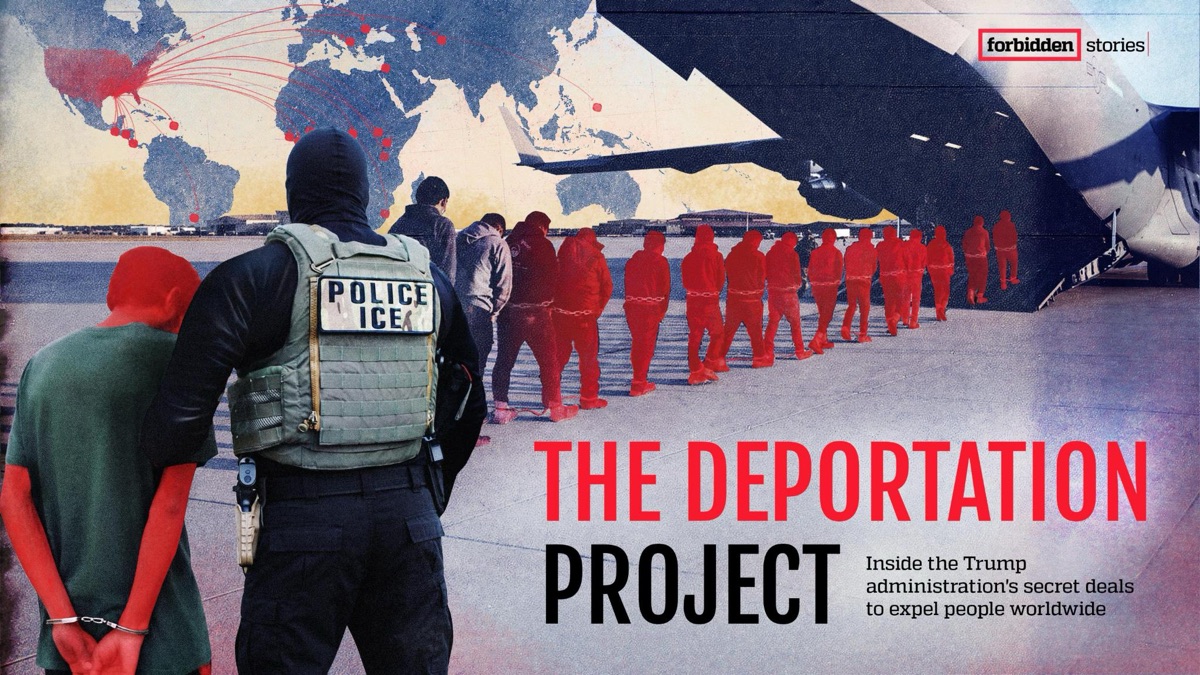
The authors are deeply grateful to the incredible team of individuals and organizations who have worked tirelessly to identify the U.S. government's current third country removal policies and practices and their impact on refugees and migrants. Our sincerest thanks go to Forbidden Stories, as well as the 72 journalists and 25 media organizations who contributed to The Deportation Project - Inside the Trump administration's secret deals to expel people worldwide, of which this report is a part; Eugenia Carbone at the Auschwitz Institute for the Prevention of Genocide and Atrocity Crimes; Blaine Bookey and Julie Bourdoiseau at the Center for Gender and Refugee Studies; Cristosal; Michael Sparks at Evident; Ian Kysel (Clinical Professor of Law, Cornell), Bella Mosselmans (Director), Beatrice Njeri (Regional Litigator for Africa), and Natasha Perez (Lawyer for the Americas) at the Global Strategic Litigation Council; Almudena Bernabeu and Michael Reed at Guernica Centre for International Justice; Scott Busby and Savi Arvey at Human Rights First; Lucas Guttentag (Director) at the Immigration Policy Tracking Project; Trina Realmuto and the National Immigration Litigation Alliance; Grace Willis and Bridget Franzatelli of the National Immigration Project of the National Lawyers Guild; Yael Schacher at Refugees International; Sarah Stillman; and David Hausman at the Deportation Data Project at UC Berkeley.